
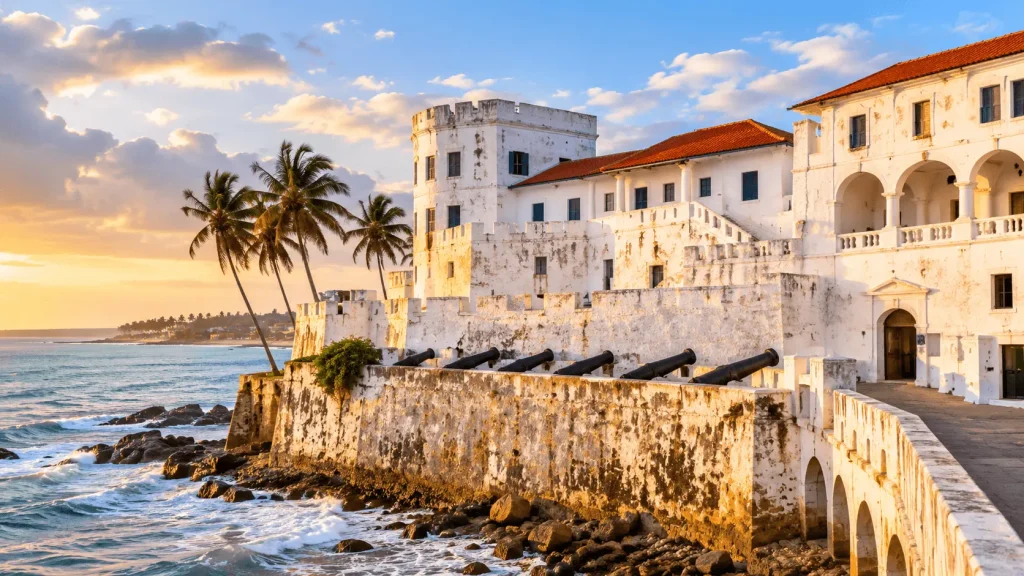
Few places in Ghana bring the country’s history into sharper focus than Cape Coast Castle.
Standing beside the Atlantic Ocean in Cape Coast, the historic castle is one of Ghana’s most important heritage attractions. Its white walls and imposing architecture make it immediately recognizable, but the significance of the site goes far beyond its appearance.
Cape Coast Castle preserves important chapters of Ghana’s history, including European trade, colonial administration and the transatlantic slave trade. Today, it operates as a historical museum and remains one of the country’s most important destinations for heritage tourism.
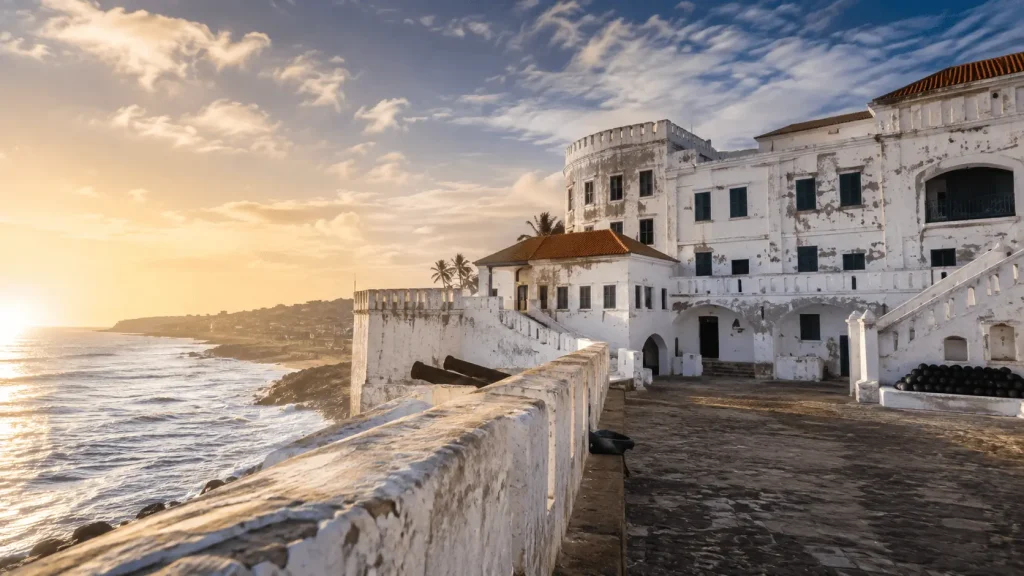
The history of Cape Coast Castle
The present castle developed through centuries of European competition along Ghana’s coast.
The site was controlled by different European powers, while the English eventually became the dominant authority. Cape Coast Castle was rebuilt after suffering major damage during the Seven Years’ War and subsequently became an important centre of British administration.
The castle also became deeply connected with the transatlantic slave trade. The Ghana Museums and Monuments Board records that the slave trade was a principal part of the castle’s role until Britain abolished its participation in the trade in 1807.
After the abolition of the slave trade, the castle’s functions changed. It became associated with other forms of commerce and eventually served administrative and educational purposes.
Why Cape Coast Castle is important
Cape Coast Castle forms part of the larger Forts and Castles of Ghana UNESCO World Heritage property.
UNESCO describes the collection as a group of fortified trading posts established between 1482 and 1786 along roughly 500 kilometres of Ghana’s coastline. These sites document more than four centuries of European-African encounters, initially through trade and later through the slave trade.
This wider historical context makes Cape Coast Castle particularly important.
A visit isn’t simply an opportunity to see an old European-style building. It provides an opportunity to understand how Ghana’s coastline became connected to major global economic and political systems.
What can you see at Cape Coast Castle?
Visitors can explore the castle’s courtyards, rooms, defensive structures and historical spaces.
The site currently functions as a historical museum and also has a Ghanaian arts and crafts gift shop.
The architecture itself tells part of the story. Thick walls, narrow passages, courtyards and ocean-facing fortifications demonstrate how the building evolved from a trading post into a major fortified complex.
For the best experience, allow enough time to take in the historical interpretation rather than treating the castle as a quick photo stop.
Cape Coast Castle and the African diaspora
The castle has particular significance for people of African descent around the world.
Ghana’s castles and forts are internationally recognized as powerful symbols connected to the history of the African diaspora. UNESCO specifically identifies these monuments as important representations of European-African encounters and the origins of the African diaspora.
For many visitors, therefore, Cape Coast Castle can be an emotional and reflective experience as well as a tourism activity.
Cape Coast Castle opening hours and entrance fees
The Ghana Museums and Monuments Board currently lists Cape Coast Castle as open daily from 9:00 a.m. to 4:30 p.m.
Its published entrance fees include different rates for Ghanaian and non-Ghanaian visitors, with the current fee schedule on the GMMB page noted as having been reviewed in July 2023. Because fees can change, visitors should verify the latest charges before travelling.
How long should you spend there?
Plan for at least a couple of hours if you want to explore the castle properly and take a guided tour.
Cape Coast is also an excellent base for exploring other attractions in the Central Region.
Attractions to combine with Cape Coast Castle
A GhanaRooms itinerary could combine:
- Kakum National Park
- Elmina Castle
- Cape Coast beaches
- Elmina fishing harbour
- Fort St. Jago
- Other historic forts along the Central Region coast
This makes Cape Coast particularly attractive for a weekend or multi-day trip.
Where to stay when visiting Cape Coast Castle
If Cape Coast Castle is part of your Ghana itinerary, staying in Cape Coast can make it easier to combine several Central Region attractions without spending your entire trip travelling between destinations.
GhanaRooms travel tip:
Explore accommodation in Cape Coast and choose a property that gives you convenient access to Cape Coast Castle, Kakum National Park and Elmina.
Explore places to stay in Cape Coast on GhanaRooms